


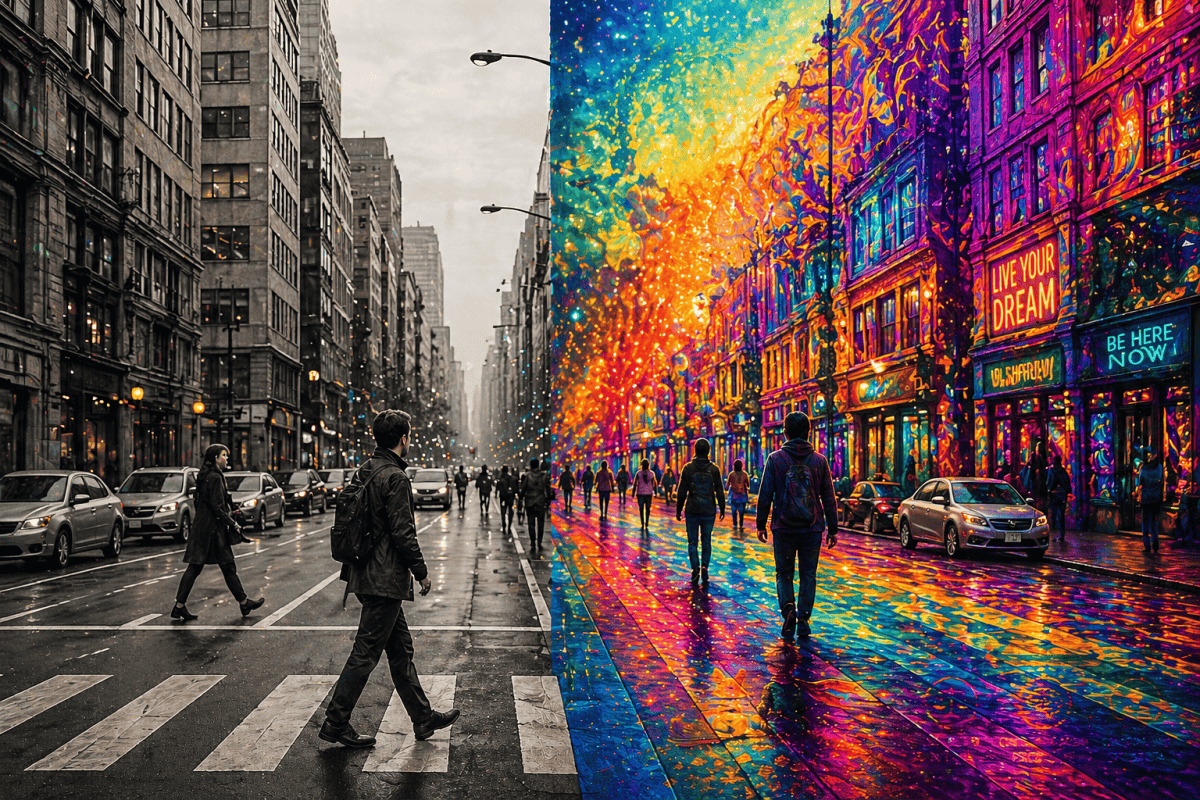
What is the psychedelic experience?
It has nothing to do, in itself, with taking substances. In fact, I can have psychedelic experiences in many other ways: through breathing, fasting, or even simply walking in the mountains. So what are we really talking about? Etymology gives us the answer: psychedelic means “manifestation of the psyche.” Therefore, an experience of this kind is nothing other than the subjective manifestation of what we are.
Yes, even our everyday life is a psychedelic experience, because it is the tangible and concrete manifestation of what we are.
I repeat this because I have seen how often this truth is not understood: life is psychedelic, literally. It is the exact manifestation of what we are.
Contents
Reality as a Mirror
Reality is a mirror. Reality is Maya, that is, illusion. Reality is a dream, and the one who steps out of this identification is called “Awakened.”
In psychology, the same thing is said, but it is usually limited to certain moments, when we speak of “projective mechanisms.” Yet these are not isolated episodes; they concern everything we perceive as real and objective. What we call “reality” is only a perception filtered through projective mechanisms, as well as through neurophysiological processes.
Buddhism says the same thing: we perceive “what is” through the “obscuring veils,” which are nothing other than emotions and thoughts standing between us and true reality. In other words, they are what psychology might call projective mechanisms.
The Allegory of the Cave
Plato tells us about the “cave” in which we live, where chained human beings watch shadows projected onto the wall in front of them, completely lost in the conviction that what they are seeing is real, while in fact they are only shadows of what truly exists outside the cave.
This allegory concerns each one of us, and yet we are usually convinced that it concerns everyone else but not us. We believe we are awake, after all, because we clearly remember waking up this morning when the alarm went off.

No one believes they could mistake shadows for things as they really are, and no one imagines that those who left the cave and then returned to tell the others what they had discovered could be persecuted for it. And yet, when the person returns, the others do not believe him; they mock him and even threaten him.
But the worst part is not the more or less explicit reaction of the others. The true tragedy is thinking that this does not concern us, that we are already awake even if things in our life are not going well at all. But how unlucky we are!
Psychedelia and Everyday Life
So, the reality we live in is a dream: we are asleep while believing we are awake. Around us we see only ourselves, and yet we believe what we see is real and objective, when in fact it is the realm of pure subjectivity.
What does this have to do with the psychedelic experience I was asking about at the beginning of this post?
The difference between the word psychedelic applied to a trip and applied to everyday life is only a matter of amplification. During a trip, everything is amplified, and this gives greater emphasis and contrast to what we are already used to and take for granted in daily life. But it is the exact same thing.
During a trip and during an ordinary day, I always see and perceive the same things; only, with the use of a substance, everything becomes more intense and more contrasted. The world has no will of its own. It is only the manifestation of my psyche, of who I am.
In other words, it is psychedelic.
If life itself is psychedelic, then a map is not useful only when we take a substance. It is useful every time we want to better understand the way our consciousness builds, interprets, and transforms the reality we experience.
The Role of Set and Setting
I believe a trip can help us see things as they are, but in order for that to happen I must master Set and Setting, because the substance itself is useless.
As Stanislav Grof says, psychedelics “do not have a specific pharmacological effect.” This means they do not produce effects linked to their chemical composition or to a biochemical interaction with our psychophysical system in the way ordinary drugs do. They are only “catalysts and amplifiers of psychological processes.”
The psychological processes are us. So why should I be interested in the substance itself if, in some cases, it may even do nothing at all, as sometimes happens? Grof mentions patients who experienced no effect even with extremely high doses of LSD, for example more than 1,000 or 1,500 micrograms.
If the substance does not produce specific effects of its own, then what must I work on in order to use it as a tool? On myself, and on the context in which I make the journey.
That means Set and Setting—and music. Nothing else is needed, also because nothing else exists.
My Second Book and the Purpose of This Post
This is the theme of my second book, The Psychedelic Experience – Preparation and Integration. Of course, I recommend it to you, but in this post I would like to give you a few useful elements to reflect on and to stimulate your desire to understand more deeply.
Set: Working on Yourself
Let us begin with Set. What is it?
It is me: how I feel, what I think, which emotions I am experiencing, and which beliefs and convictions orient my perception of who I am and of what life around me is. Set is the one who enters the psychedelic journey and determines it. The trip is an amplification of what I am, not the consequence of a dose of a substance.
If I am deeply and unconsciously convinced that I am “X,” then inside the journey I will find only that, because the journey is a manifestation of my psyche.
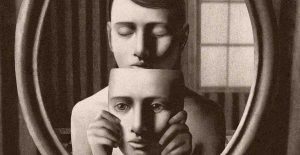
Working on Set, therefore, means working on myself. It means preparing for the inner journey by aligning both the conscious and the unconscious in order to navigate in the desired direction. There are many ways to do this, but they must be known and understood if we want to use them properly.
A fundamental question to answer before going deeply into this territory is this: Who am I?
I know that humanity has been repeating this question forever, but the answer exists, and it is extraordinarily simple, useful, and easy to understand and use when needed.
Setting: The Stage of the Experience
Setting is the second element that determines the direction the inner experience will take. It is fundamental because it prepares the stage on which the representation of my psychedelic experience will unfold—and remember, psychedelic means “manifestation of the psyche.”

Setting is the stage on which my psyche manifests. The way I prepare it, the elements I use, and above all the music I choose will determine the screenplay of the movie I will see—and live—during the journey.
Integration
Finally, there is integration, which means two different things that can sometimes be complementary.
The first is integrating the trauma of a difficult experience, which generally does not occur when Set and Setting have been designed correctly.
The second is integrating in order to mentally understand the insights and realizations that occurred during the journey.

Sometimes everything is clear. Other times, however, it is necessary to “translate” what happened into terms that are comprehensible to the ordinary state of consciousness to which you return after the journey.
The True Purpose of the Journey
Now we come to what I consider the most important point, the one that is fundamental if the psychedelic journey is to help us enter a special state of consciousness that allows us to see reality for what it is, without the perceptual filters that alter it and make us see it as a “mirror” of what we are.
Certainly, psychedelics can be used in many other ways. A tool produces results according to how we use it: therapeutically, playfully or recreationally—for example, nature and music under the effect can be incredible—spiritually, and so on.
But all these uses are less interesting when compared with the possibility of directly experiencing moments of Awakening of Consciousness.
Dream or Awakening?
Why do I say this? Is experiencing mystical moments of connection with the Universe not more important? I do not know. But who is the one experiencing those ineffable mystical moments?
Let me explain.
If I dream that I am connected with the Divine, or if I dream that I am being chased by a fierce demon, which is better? Neither. It is still a dream. Obviously, one is more pleasant than the other, but both end instantly as soon as I wake up.
It is different to “wake up” and have a direct experience of what reality is like without the obscuring veils, reality without Maya.
One thing is to dream—as almost all of humanity on this beautiful planet does. Another thing is to wake up and finally see things as they truly are.
The practical consequences for daily life are completely different: a beautiful dream ends as soon as the alarm clock rings, while an awakening of consciousness is always illuminated by Truth. Finally, I see things as they are. I step out of Plato’s Cave and see the matrix of the shadows I had mistaken for reality: the World of Ideas.
Conclusion
For today, I would say this is enough. We will continue soon, but first reflect on this sentence from The Little Prince:
“What is essential is invisible to the eye; one sees clearly only with the heart.”

Warnings
WARNING: Psychedelics are illegal in many countries. There are also psychophysical contraindications that must be known. Read the dedicated post to learn more and protect your health. For any problem, consult a specialist: do-it-yourself is dangerous, always.