


If you were dropped into an unknown jungle and had a good map, you would probably be able to find your way more easily. Not because the map is the jungle, but because it would help you recognize what you are observing.
In the previous posts, we saw that reality is psychedelic in the etymological sense of the word: it is a manifestation of the psyche. We also saw that the reality we perceive is a mirror, and that the psychedelic journey is nothing more than an amplification of what we are. If this is true, then an inevitable consequence emerges: in order to know the world, I must know myself.
This is not a philosophical or spiritual statement. It is a logical consequence.
If the world I perceive is filtered through my thoughts, my emotions, my beliefs, and my identifications, then I cannot truly know what I am observing without first knowing the one who is observing.
This is where the real work begins, and this is where a cognitive map becomes necessary.
Contents
The Problem Is Not the World
Generally, we believe the problem is outside of us. We are irritated by someone’s behavior, hurt by a situation, obstructed by circumstances, limited by others. We think that if the world were different, we could finally feel okay.
And yet, when we observe carefully, we discover something curious: different people react in completely different ways to the same events. A situation that is a tragedy for one person may be an opportunity for another. A criticism that destroys one person leaves another completely indifferent. A failure that breaks someone down becomes the starting point for someone else.
The event is the same; what changes is the observer.
This simple observation should make us reflect. Perhaps the point is not so much to understand the world, but to understand through which filters we are observing it. If the reality we perceive is a mirror, then knowing the world and knowing oneself become two aspects of the same search.
The First—and Only—Law of the Map
The first law of the map is very simple: we do not see reality as it is, but as we are.
I know this statement may sound extreme, but all we need to do is observe our everyday experience to realize that this is exactly what happens. We do not react to events themselves, but to the interpretation we give them, as Epictetus said. We do not live in reality, but in the representation of reality that our mind constructs. Remember: what we see is only a reconstruction made by the brain, starting from the impulses that arrive through the optic nerves. The brain does not see; it reconstructs.
This is why many very different traditions have used words such as illusion, Maya, dream, or cave. They are not saying that the world does not exist, but that what we perceive is inevitably filtered through our psychological structure. We perceive the world through the “obscuring veils” spoken of in the Buddhist tradition, which are nothing other than emotions and thoughts. Lifting the veils allows us to see reality for what it is.
If this is true, then reality takes on a completely different function. It is no longer merely the place where we live; it becomes an instrument of knowledge. Every relationship, every fear, every conflict, every desire, every attraction, and every judgment can tell us something about ourselves.
The question stops being, “What is happening?” and becomes, “What is what is happening showing me about myself?”

What Should I Observe?
At this point, a fundamental question arises. If I want to know myself, what should I observe?
The answer I have given myself over the years is surprisingly simple: I must observe how my personality functions—which is something distinct from what I deeply am. Here is a very important clue, one you should always remember: if it touches me, it concerns me.
I would not start from great metaphysical speculations. I would not start from the question “Who am I really?”—at least not at the beginning. I would start from something much more concrete and verifiable: how do I function?
What makes me angry? What scares me? What do I desire? What do I judge? Which situations keep repeating themselves in my life? Which people always seem to press the same buttons? Which patterns return again and again?
Before we can know who we are, we must notice how mechanical we are.
This statement may feel uncomfortable, but sincere observation quickly confirms it. Much of our life consists of automatic reactions, habits, conditioning, and repetitive patterns that are activated whenever certain conditions arise. We think we are choosing freely, but very often we are simply reacting according to programs that have been repeating themselves for years. This is why esoteric traditions say that the ordinary human being has no Free Will.
Seeing these automatisms is one of the first concrete results of self-observation. Seeing does not mean judging, because judgment itself is a thought. What is necessary, then, is simply to observe oneself without judgment and, if self-judgment does arise, to notice it as well—to see it in a neutral and detached way.
The Three Dimensions of Identification
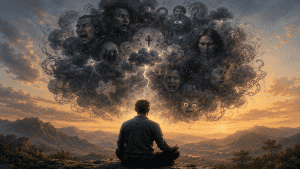
To orient myself in this work, I use a very simple map. The human being can be observed through three main dimensions: the physical level, the emotional level, and the mental level.
On the physical level, we find the body, instincts, biological needs, tensions, habits, and everything that belongs to our bodily dimension.
On the emotional level, we find fears, desires, attachments, enthusiasms, aversions, and the entire movement of emotions that continuously passes through our experience.
On the mental level, we find thoughts, beliefs, opinions, points of view, judgments, interpretations, images of ourselves and of the world, and convictions that we often consider true without ever having asked where they come from.
These three levels interact continuously and determine a large part of our everyday experience. The problem is not their existence. The problem is identification.
Normally, we do not observe these processes: we become them.
When a fear appears, we do not realize that we are observing a fear; we become that fear. The same happens with anger, with desire, and with the thoughts that pass through the mind. We do not say, “I am observing anger”; we say, “I am angry.” We do not say, “I am observing a thought”; we believe we are that thought.
It is precisely this identification that prevents us from clearly seeing what is happening within us.

Self-Observation
Self-observation introduces a fundamental novelty: a small distance.
It does not eliminate emotions, it does not eliminate thoughts, and it does not eliminate automatic behaviors. But it does allow us to recognize them.
This may seem like a minimal difference, but it completely changes the perspective. When I begin to observe myself consistently, I start to notice that certain emotions always return, that certain situations regularly activate the same reactions, and that many conflicts repeat themselves according to surprisingly similar patterns. I begin to see patterns. And when I see a pattern that repeats, I am seeing something about myself that was previously invisible.
This is why I keep saying that reality is a mirror. Not because the world is a fantasy produced by the mind, but because the way I experience it continuously reflects my inner structure. If I sincerely observe what happens to me, life becomes an extraordinary training ground for self-knowledge. Relationships become mirrors, conflicts become mirrors, fears become mirrors. Even pleasant experiences become mirrors.
Everything speaks to me about myself, but only if I am willing to listen.
The Psychedelic Path
At this point, we can return to psychedelia.
What, after all, is a psychedelic substance? Once again, etymology helps us: manifestation of the psyche. We are not talking about something that adds foreign content to our experience. We are talking about something that amplifies, makes more evident, and increases the contrast of what is already present.
For this reason, I continue to maintain that psychedelics are not the most important part of the journey. The important part is you. The substance does not create your mind; it manifests it. It does not create your inner dynamics; it amplifies them. It does not invent your psychic content; it makes it more visible. It is a bit like increasing the brightness of a screen: the images were already there, but now you can see them more clearly.
If ordinary reality is already psychedelic because it continuously manifests what we are, then the psychedelic state is simply an amplification of this process and makes it easier to observe—if you know how to do it. Consciousness is free; self-awareness, on the other hand, is the result of work on oneself, which begins with self-remembering and continuous self-observation.
From the Ordinary State to the Psychedelic State
Self-observation can be practiced at any moment of the day. In fact, it should be practiced especially in everyday life, because that is where the automatisms that govern our existence manifest themselves: while you are talking with someone, while you are working, while you are feeling fear, when you feel hurt or desire something, while you are judging or being judged.
The psychedelic state represents a particular condition that can greatly facilitate this work. Identification can loosen, the usual boundaries of the personality can become less rigid, and certain mechanisms that normally go unnoticed can appear more clearly—see how the DMN, the Default Mode Network, functions.
Of course, this does not happen automatically. This is precisely where set, setting, and music come into play. When these elements are properly designed, the journey can become an extraordinary instrument for self-observation and self-understanding. It does not always happen, but when it does, something that was previously only a concept is directly understood.
From Understanding Intellectually to Comprehending Directly
This is where a distinction I consider fundamental returns: understanding intellectually and comprehending directly are not the same thing.
I can mentally understand that I am identified with my thoughts or with my emotions. I can read dozens of books about consciousness, presence, and awakening. I can even teach these concepts to other people. But comprehension arises in a completely different moment: when I directly see the mechanism at work within me, when I have a direct experience of it—not only on a mental level. This happens when I observe a fear as it is being born, when I recognize a judgment as it is forming, or even when I see an automatic reaction in the very moment it manifests.
In that instant, I am no longer accumulating information. I am observing the reality of my direct experience, and it is precisely this comprehension that can begin to transform the way we live. The daily journaling practice, which you can read about HERE, helps you develop the ability to observe yourself every day.
The True Purpose of the Map
The map is not meant to accumulate knowledge; it is meant to help us orient ourselves. It is not meant to build new beliefs; it is only meant to help us observe and recognize what is already present. It is not meant to create a more refined spiritual identity, but to recognize all the identities with which we are continuously identified.
If reality is truly a mirror, then the first map we must learn to read is not the map of the world, but the map of ourselves. And it is precisely through this observation that the world gradually begins to reveal its nature. The world does not have a will of its own, but represents and expresses our will—and this is true for each one of us.
The question, then, is no longer what I must do to change my life, but who is the one living this life, and through which mechanisms is he constructing it moment by moment. This is where inner work becomes real, and it is also the point where the map we have just begun to trace can become a concrete instrument of transformation.
But we will talk about this in the next post.
Warnings
The use of psychedelics in many countries is prohibited. Furthermore, there are psychophysical contraindications that must be known. Read this post to learn more and protect your health. For any problem, consult a specialist: do-it-yourself is dangerous, always.
thank you for this helpful article on psychedelic therapy.
Thanks to you Farzin!