

Over the past few months, I have become deeply interested in artificial intelligence, both for its enormous potential and for the implications it brings with it, and I found myself connecting this interest to a passion that has been with me for many years: psychedelia. I was reminded of Steve Jobs’ 2005 Stanford commencement speech, when he talked about the dots that we can connect only by looking backward. Now, as I approach retirement age, I realize that many of the things I pursued out of curiosity and passion are beginning to reveal new connections.
I love psilocybe mushrooms, but they are not the object of my passion: they are tools I have used to explore and get to know myself, as the Temet Nosce on the covers of my books reminds us. This is where, in my thinking, AI and psychedelia begin to meet: one develops the functions of the mind to an extraordinary degree, while the other can loosen our identification with that same mind and allow us to observe it as a tool. Coming from opposite directions, both bring us back to a question that is anything but technological: if a machine can outperform me at the very things through which I define myself, then who am I?
Contents
Artificial intelligence puts us face-to-face with ourselves
What is artificial intelligence if not a tool that amplifies and enhances the capacities we typically associate with the mind? Here I am talking about intelligence as the ability to connect, process, analyze, and synthesize, to the point of producing new associations among things we already know. In some tasks, AI already surpasses human performance, and I am convinced that this advantage will continue to grow. I see it as the technological expression of the mental dimension, developed to a degree of power that, until recently, we would have struggled to imagine.
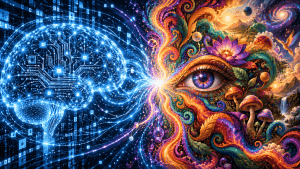
I do not feel threatened by this prospect, even though the dangers connected with the development and use of AI do exist. As a science-fiction enthusiast, I have little difficulty imagining them. What interests me here is another consequence: the more technology becomes capable of performing the functions of the mind, the more useful it becomes to ask whether the mind is what we are, or whether it is a tool we possess—precious, certainly, but different from the one who uses it.
The question has a history far older than computers. In Who Am I?, Ramana Maharshi invites us to investigate our identity by moving through everything with which we ordinarily confuse it: the body, the senses, the faculties of action, the mind. After excluding these identifications, his answer contains a passage that I translate this way: “That Awareness which alone remains—that I am.” This is the meaning of neti neti, not this, not this, which for me offers a very concrete direction for inquiry: recognizing what we observe and asking ourselves who is aware of it.
The horizontal mind and the three poisons
To explain what I mean, I need to clarify what I call horizontal thinking. It is the plane on which the mind connects facts, distinguishes objects, compares information, and reconstructs causes and consequences. It is the plane on which we study, work, and organize our lives, and on which AI can become an extraordinarily powerful tool. From the perspective I am writing from, however, the mind remains immersed in duality: there is a subject observing and something being observed; there is what I recognize as myself and what I consider other than myself.
This separation also runs through our emotions and our relationship with the body, which together with the mind make up what I call the personality, and it easily turns into a constant taking of sides: I like it or I don’t like it, it is beautiful or ugly, right or wrong. We therefore find ourselves chasing certain experiences and rejecting others, often without realizing how deeply this movement conditions the way we see the world.
The Buddhist tradition represents the three poisons in the Wheel of Life that cause suffering: attachment, represented by the rooster, aversion by the snake, and ignorance by the pig. Attraction and repulsion make that familiar “I like it, I don’t like it” immediately recognizable, and it is a representation of duality. In my reading, ignorance of this mechanism, and of the identification that keeps us trapped within it, keeps us prisoners of samsara, the cycle of conditioned existence and suffering.
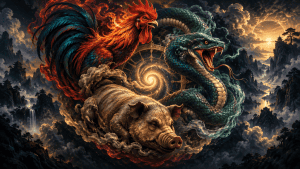
If I like something, there will be something I do not like, and in trying to hold on to the first and push away the second, I continually find myself resisting what is happening. It is this inner resistance that becomes suffering: a struggle between what I am experiencing and what I insist on experiencing instead. I recognize this in the psychedelic experience as well, when I try to control, block, or reject what emerges. Understanding this mechanism is relevant both to the psychedelic journey and to everyday life.
From vertical thinking to intuition
A reference I like for beginning to change perspective is the vertical analogical thinking of Thorwald Dethlefsen, author of The Challenge of Fate. Its subtitle, Esoteric Psychology, already points to the attempt to show that thought is not exhausted by linear connections and cause-and-effect relationships. Think of a monk, an ibex, a cemetery, lead, the color black, dark green, and lime: on the horizontal plane they have nothing in common, yet they belong to the same analogical chain of meaning because, in different forms and on different planes, they manifest the qualities of Saturn. The forms change, but the quality they express remains the same.
This example introduces a different way of reading what lies before us, but the vertical movement I am talking about goes beyond the ability to construct analogies—something an AI could also do. In the philosophical perspective I follow, intuition, inspiration, and contemplation come from a supramental plane, outside the dimension of the personality, which is made up of the physical, emotional, and mental. The mind can try to translate what comes from that plane, but it is not its source. When I think of the Muses as intermediaries between the divine and the human, this is precisely what I mean by the source of inspiration.

This is also why I find it important to remember the meaning of psychedelic: manifestation of the psyche, from the Greek ψυχή (psychḗ), which can also mean “soul.” It is in this broader meaning that I recognize myself, because the research I pursue concerns the awakening of consciousness and the possibility of knowing ourselves beyond identification with the physical, emotional, and mental.
This is the transpersonal perspective from which I write: learning to see through the heart, understood as a center of understanding beyond the filters of the mind and our emotional reactions. I am reminded of the line from The Little Prince by Antoine de Saint-Exupéry: “It is only with the heart that one can see rightly. What is essential is invisible to the eye.”
When I use the word metaphysics, I am referring to reality beyond the forms and phenomena through which we ordinarily know it. In the philosophical view I follow, it indicates that which does not depend on the changing forms through which reality manifests itself. The mind can try to describe it, but understanding it through direct experience is something else—something that requires a change in the state of consciousness.
This passage is fundamental: as I understand intuition and contemplation, accessing that dimension means entering a non-ordinary state of consciousness, beyond the usual functioning of the mind—inspiration and intuition cannot be accessed through the mind! Psychedelics are one of the tools through which these states can be explored, together with other practices, including meditation. It is the lived experience of that dimension, rather than the ability to describe it, that I consider beyond the reach of AI. But the same limitation applies to a human being who has not directly experienced it, because being able to talk about intuition or contemplation is not the same as living them and therefore “understanding” them.
Psychedelia and the experience of the witness
Psychedelics, together with other practices for exploring consciousness, can loosen that powerful identification that makes us believe we are our thoughts, our emotions, and our physical body. In the path I describe, preparation, set & setting, and subsequent integration play an essential role, because the meaning of the experience lies in recognizing something about ourselves and finding a way to bring it into everyday life.
When I speak of the witness, I mean precisely this possibility of being present to what is happening without being completely absorbed by what I am experiencing. I can feel an intense emotion and, at the same time, recognize that there is an awareness of that emotion. I can watch a thought form without having to immediately believe it, follow it, or fight it. It is the shift from “I am angry” to “I feel the energy of anger within me”: the point from which I recognize myself changes, because I am able to be aware of what I feel without coinciding with it.
In this self-observation, judgment deserves particular attention: when I comment on or judge what I see, I am already using a function of the mind and have re-entered its duality. The witness, in the sense in which I use the term, observes without commenting and without judging. It is a presence that recognizes what is happening without taking sides, without having to immediately define it as right or wrong. It is simply presence.
This is a path that requires time, practice, and continuity—sometimes a great deal of time. It reminds me of Don Juan’s impeccable warrior in Carlos Castaneda’s books: in my reading, “stalking” is directed toward our own automatic patterns, the thoughts and emotional reactions that govern us without our realizing it, while “stopping the world” means interrupting the mental description that we mistake for reality. Self-observation prepares the ground for this opening without making it automatic. It may arrive suddenly, but recognizing it while it happens makes it possible to bring that understanding into everyday life.

Think of the experience of a terminally ill person who feels that everything they believe themselves to be is coming to an end, because their identity coincides with the body that is wasting away, with the emotions moving through them, and with the thoughts telling them what is about to happen. If, during a psychedelic experience, this identification loosens, their relationship with death may change profoundly: what is ending may no longer be perceived as the totality of who they are.
In clinical studies of psilocybin in people with potentially life-threatening cancers, reductions in death-related anxiety have also been observed. My interpretation of this possible change is that, in an experience that is properly prepared, supported, and integrated, a person may perceive themselves as being more than what they have always identified with, even without being able to explain it rationally. It is this inner experience that interests me: the possibility of recognizing oneself in something that transcends those three planes of human existence. In esoteric language, this is called “shifting identification from the personality to the soul.”
The map: preparation, experience, and integration
Preparation serves to build a cognitive map that helps us orient ourselves in unknown territory. Through study, we acquire reference points that, during the experience, can help us recognize what we are encountering, even when it appears in forms very different from what we had imagined: knowing helps us recognize. The map is not the territory, but it is a precious tool for finding our way within it.
Its value continues even after the experience is over, because those same reference points can help us during integration. What we learned during preparation and recognized during the journey can become a bridge between direct experience and everyday life, even though translating those understandings into the language of the ordinary mind often remains difficult. The cognitive material available to us may not be enough to express what we grasped intuitively, but having built a map beforehand makes it easier to recover its meaning and understand how to bring it into our lives.
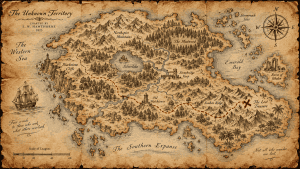
In this work, poetry, images, and music can also help us reconnect with the quality of a non-ordinary state of consciousness, loosening our habitual way of interpreting what we experience. They can make something accessible again that reasoning alone struggles to recover, and help us give form to the intuitions we have had so that they can become understandings we can use in everyday life.
To describe our habitual patterns, I find the image of a “grid” effective. At the neurobiological level, research on psilocybin has observed changes in communication among brain networks, particularly pronounced in the Default Mode Network, a network also involved in the sense of self. A small clinical study on obsessive-compulsive disorder, OCD, also found a reduction in symptoms following psilocybin treatment. Speaking of a “reset” may convey the idea of an opening toward different ways of feeling and thinking, but it remains a metaphor: the mechanism behind the clinical improvement and the specific role of the Default Mode Network are still being studied.
I have explored these themes in greater depth in the posts Paradigms, Consciousness and Psychedelia, What Is the Psychedelic Experience?, and The Psychedelic Map for the Awakening of Consciousness, because this is precisely the meaning of the work I am carrying forward: building maps that support self-knowledge.
Grof, the rainbow, and the reality we believe to be real
Stanislav Grof devoted a book to these territories with the very appropriate title When the Impossible Happens, in which he recounts experiences that challenge the boundaries of our ordinary idea of reality. Reading his accounts, I arrive at a precise conclusion: to understand them in the sense he gives them, we need to step outside the assumptions of the materialistic and mechanistic paradigm, within which those phenomena are impossible. This is one of the reasons I consider the human being multidimensional and believe that what we can measure about human functioning does not exhaust our understanding of it.
The rainbow offers a simple image for reflecting on phenomenal reality. We see it, we can photograph it and point it out to someone, but it does not exist as an independent object. In fact, it appears through the simultaneous presence of light, water droplets, and the position of the observer. When those conditions change, the rainbow changes as well, until it disappears. For me, it is a particularly effective example both of conditioned existence and of the impermanence emphasized by Buddhism.

In my reading, illusion begins when we attribute an autonomous, stable, definitive existence to what appears, forgetting the conditions that make it possible. It is in this sense that I refer to māyā: we take phenomenal reality to be the whole of reality, while the mind continues to process it from within, on the horizontal plane. AI can make this processing enormously more powerful. The question that interests me is whether we can also recognize the limits of the plane from which we are observing ourselves and our lives.
An opportunity to know ourselves
At this point, it becomes clearer where, at least in the path I am describing, artificial intelligence and psychedelia meet. AI develops and amplifies the functions of the mind to the point of showing us that some of the abilities in which we have placed an important part of our identity can be technologically reproduced and, in some cases, surpassed. Psychedelia can make a different and complementary movement: it can loosen our identification with the mind and allow us to observe it as one of the tools available to us, together with the physical body and emotions.
It strikes me that the rise of AI is happening at a time when every process seems to be accelerating and many issues are coming to a head. Terence McKenna was already talking about increasing novelty and complexity, trying to describe an acceleration he perceived in human history. I do not consider AI a confirmation of his predictions, but I find it interesting that this very technology is forcing us today to reconsider, at a speed we have never experienced before, what we thought we knew about intelligence and about ourselves.
The fact that a technology may surpass us in some mental functions does not diminish human value. Instead, it makes it less and less meaningful to identify human beings with those abilities. The mind remains an extraordinary tool, but AI itself places us in a position to recognize this more clearly. The question is no longer only what a machine will be able to do, but who we are when we stop measuring ourselves by what our minds can do.
 This is the meaning of the project I have called “Evolutive Psychedelia | Maps for Self-Knowledge”: building maps that accompany preparation, experience, and integration, so that psychedelic exploration does not end with what happens during the journey, but becomes a concrete tool for self-knowledge. The map can help us recognize what the experience shows us and, above all, bring it into everyday life. This is because the psychedelic experience and everyday life are not two separate things: both are manifestations of our psyche.
If I return to the question I started from—if a machine can outperform me at the very things through which I define myself, then who am I?—the answer I recognize in my own experience is this: I am that which is aware of the body, emotions, and thoughts. It is the possibility of developing the witness through self-observation, learning to be present to ourselves and to observe the personality without completely identifying with it. AI and psychedelia arrive at this question from very different directions: one by showing us how far the mind can go, the other by allowing us to directly experience the fact that we are not only that mind, nor even the personality composed of the physical, emotional, and mental. When identification with the personality ceases, we awaken and remember who we truly are: the soul.
Welcome, AI. Long live psychedelia!
If you enjoyed this post and found it useful, would you buy me a coffee?
https://www.buymeacoffee.com/DMTripson